Usuarios conectados
Total: 2064
Registrados: 4
 |  | |
| ...y Más | ||
MORE INFORMATION ON THE IRANIAN HANDICRAFTS ✏️ Compras-Iran Autor: Oficinas-Turismo
⭐ 5.0 (4 Votos)
Autor: Oficinas-Turismo
⭐ 5.0 (4 Votos)
The Iranian craft shows wonderful works in leather, metal, blown glass, enamels, wood inlays, miniatures, etc.. These are a sample of them. 
Glass Blowing Work The discovery of many glassware shows that the history dates back to the time of Parthians and the Sassanids. Glass is a transparent, fragile substance composed of alkaline silicones produced by the process of glass blowing. It consists of the processes of shaping the melting mineral by heating it in a furnace at 1,400 centigrade, blowing into it using a special tube and other simple manual tools, and then, ornamenting it by painting, cutting, purifying, opaque making, etc. Tehran is one of the main centers for producing glassware. Meybod in the Fars Province is another region where glass blowing has been in vogue since the past centuries. Painting on Back of a Glass In this art, the back of the glass is painted. Artist history goes back to the first half of the 12th century (lunar calendar). The artist makes use of small pieces of glass and draws inverted designs and colors. For painting on back of the glass, first, the artist draws the design on a piece of kelk paper, and then transfers it onto the glass using a paintbrush and black ink.  It is very important to follow the principles. After drawing the specific design, the artist starts coloring the glass with oil paint, and finally, he uses stabilizers to fix the color and to give a beautiful glossy appearance to the glass work. Shiraz and Qazvin, and Tehran are the main centers for making this product. Wood Carving In this art, the wood is cut and carved using a horizontal cutting machine. Some well known historical objects display the antiquity of the art, for example, some engraved designs on the throne, on the legs, and on the joss stick holder belonging to Persepolis. The primary substance used in this art is aspen wood, which is shown in hookahs, the legs of sofas and table lamps. Wood Engraving In this art, embossed designs are engraved on the wood to make such useful tools as a box, a chess piece, a dervish bowl, gates of sacred places, etc. Historians consider wood engraving as one of the grand old industrial arts of Iran, especially from the time of the Arab conquest of Iran. Mazandaran province is one of the main centers for making this product. Delicate Woodwork Delicate woodwork is a traditional handicraft in northern Iran. In this art, the woodenware is veneered with a specific design, and so, the delicate woodenwares, such as spoons, forks, chess boards, various dishes, etc. are made with great care, beauty and delicacy. Delicate woodwork is popular in Urmia, Sanandaj and Rasht. Traditional Printing This kind of art is used on a large, patterned, silk handkerchief, which is used in local women's dresses as a headband or a ribbon worn round the waist, and sometimes, it is used for keeping a baby on a woman's back. Usually, batik, or traditional printing is used for patterning these handkerchiefs. Stone Carving In this art, the stone is engraved into the desired size and dimensions for specific purposes, e.g. designing stones for decorating the walls of the mosques, memorial monuments, and pedestals. The art is mostly used for making such tools as stone pots, ornamental frames, fireplaces, and chess board pieces. Great masterpieces like the walls in Achaemenian palaces in Persepolis, delicate works like the engraved ring gems, and engraved verses of the Holy Quran on the agate rings are outstanding examples of this ancient art in Iran. Traditional Tile Working Using enameled bricks has been one of the great changes in the history of architecture, which led to the production of beautiful tile. Over the years, changes in tile production have led to its evolution and its present form. It's been used in traditional, religious buildings, e.g. mosques, and memorial monuments of the past. Currently, it is used much in modern buildings. In this art, small pieces of tiles are put together, which is the method applied in façade construction because it prevents the expansion and contraction of tiles in cold and hot environments. This way, the enamels rarely fall or break into pieces. The designs vary from vertical, horizontal, and oblique straight lines of 45 degrees as well as checkered patterns. Tile working is also used in Kufi Bannai (architectural Kufi) writings as a part of the decoration in Islamic monumental architecture in Iran. Based on the type of production, traditional tile working falls into the following categories, each described above under a separate entry: gold-plated tile, inlaid tile, enameled tile, and seven-colored tile. Perhaps the history of enameled brick (tile) dates back to the time of Babel in the 2nd century BC. What has been found from this type of tile belongs to the Achaemenian period, which has been found in most of the buildings on the Iranian Plateau, especially those of the 5th century BC in Susa and Persepolis. Nowadays, this product is made in most of the Iranian cities, including Esfahan, Mashhad, Tehran and Qom. Khatamkari A delicate and meticulous marquetry produced since the Safavid period, khatam, was so popular in the courts that princes learned this technique at the same learning level of music or painting. "Khatam" means "incrustation", and so, "Khatamkari" is "incrustation work". This craft consists of the production of incrustation patterns (generally star shaped) with thin sticks of wood (ebony, teak, ziziphus, orange and rose woods), brass (for golden parts), and camel bones (for white parts). Ivory, gold, or silver can also be used. 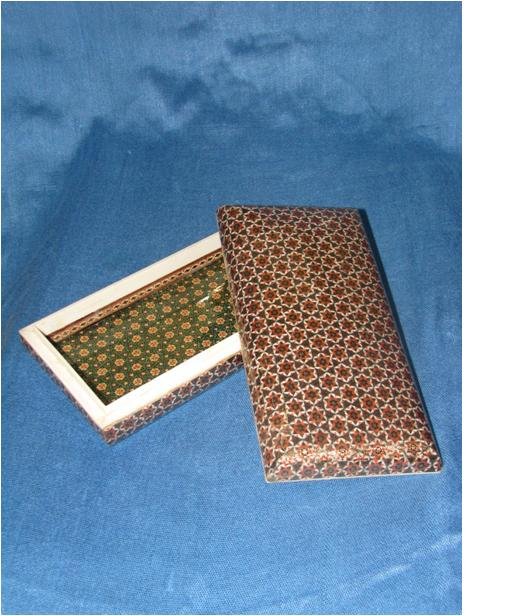 Many objects can be decorated in this fashion, such as: jewelry/ decorative boxes, chessboards, cadres, pipes, desks, frames or musical instruments. Combined with Persian miniature, Khatam leads to a fascinating work of art. This craft has existed for more than 700 years and is still perennial in Shiraz and Esfahan. Minakari "Minakari," or enameling, is the art of painting, coloring and ornamenting the surface of metals by fusing brilliant colors of an intricate design over the surface. The Iranians invented the art of enamel or minakari, and the Mongols spread it to India and other countries. Historically, gold has been used for minakari as it holds the enamel better, it lasts longer, and its lustre brings out the colors of the enamels. Silver, a later introduction, has been used for artifacts like boxes, bowls, spoons, and art pieces. Meanwhile, copperhas been used for handicraft products, and it was introduced after the globally enforced Gold Control Act, which compelled the minakari-makers to look for a material other than gold. Traditional Bookbinding Iranians are excellent in the art of bookbinding, because they reserve high values for books. In this art, which is now used for binding old manuscripts, the binder fungicides the book, presses it using a press machine, lines it, and then sews the book. After lining, single sheets are pasted to the beginning and ends of the book, and then, the band is pasted to the back of the book. When the process is done, the book is sent to a cover maker. Today, traditional bookbinding is used for restoring the old books in the precious manuscripts archive of the Islamic Consultative Assembly. Inlaid Leather In the art of inlaid leather, covers of books are made from patching pieces of leather. For making inlaid leather, appropriate types of leathers such as goat leather and ewe leather are used. Then, embossed designs of flowers, bushes, birds ; other delicate and elaborate geometrical figures such as citrons, semi-citrons, ovals, and circles; and animals' pictures are cut, arranged and pasted on leather. Sometimes, the margins are covered by embossed, goldplated designs or different colors. There is another kind of inlaid leather in which strips of narrow, delicate leather are carefully pasted on the specific cover. Mostly, the artists of Tabriz and Herat use this method to create fantastic inlaid leather book covers. Persian Miniature A Persian miniature is a small painting whether a book illustration or a separate work of art intended to be kept in an album of such works to comprise a part of the visual element of a classical literature. The techniques are broadly comparable to the Western and Byzantine traditions of miniatures in illuminated manuscripts, which probably had an influence on the origins of the Persian tradition. Although there is an equally well established Persian tradition of wall painting, the survival rate and state of preservation of miniatures is better, and the miniatures are the best-known form of Persian painting among western countries. Miniature painting became a significant Persian form in the 13th century, and the highest point in the tradition was reached in the 15th and 16th centuries. The tradition continued under some influence from western countries and has many modern exponents. The Persian miniature was the dominant influence on other Islamic miniature traditions, principally the Ottoman miniatures of Turkey and the Mughal miniatures of the Indian sub-continent. The themes of Persian miniatures are mostly related to Persian mythology and poetry. Western artists discovered the Persian miniatures around the beginning of the 20th century. Persian miniatures use pure geometry and a vivid palette. The allure of Persian miniature painting lies in its absorbing complexities and in the surprising way it relates to the nature of art and the perception of its masterpieces. Prominent Persian miniaturists include: Kamal ud-Din Bihzad Herawi: Leading miniaturist of the Timurid era, and founder of the Safavid School. Reza Abbasi: One of the most renowned Persian painters of the Safavid era. Hossein Behzad: Famous contemporary miniaturist. Mahmoud Farshchian: Famous contemporary miniaturist. Metal-Working Different types of metals are used in the various types of handicrafts produced in Iran. The most popular of these items are made out of copper, which are commonly used in Iranian kitchens. The chief centers of the art of metal workings are Esfahan, Shiraz, Kashan, Yazd and Kerman. 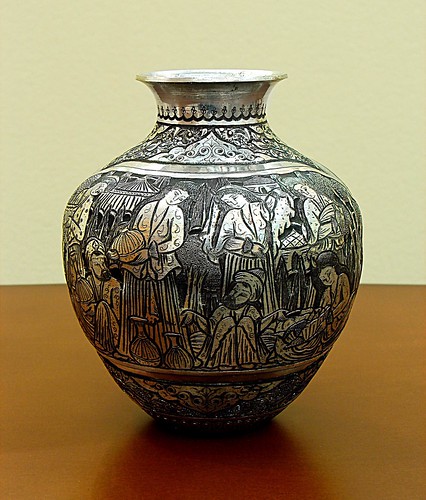 Copper kitchen articles include: pots, pans, pails, large spoons, and trays. The second category of copper items consists of picture frames, jewelry boxes, water-pipe pots and statues of various animals, which have special artistic value. FUENTES: www.tourismiran.ir Última Actualización: 14/12/2012 - 00:18 Tips relacionados  Puerta de Qeisarieh - Isfahan
 Puerta de Qeisarieh, también denominada Sardar-e Bazaar-e Qeisarieh, es la entrada norte al gran bazar
 Casas Tradicionales o Históricas de Kashan - Irán
Casas históricas o tradicionales de Kashan. Breve descripción e información.
Casas Tradicionales o Históricas de Kashan - Irán
Casas históricas o tradicionales de Kashan. Breve descripción e información.
 Abyaneh - Irán
Abyaneh (en persa: ابيانه), situado en la provincia de Isfahan, es un bonito pueblo considerado uno de los más antigüos del país, ya que se le calcula unos...
Abyaneh - Irán
Abyaneh (en persa: ابيانه), situado en la provincia de Isfahan, es un bonito pueblo considerado uno de los más antigüos del país, ya que se le calcula unos...
 TEHERÁN... transporte público y conexiones con el aeropuerto IKA
Información práctica sobre el transporte público de Teherán y...
TEHERÁN... transporte público y conexiones con el aeropuerto IKA
Información práctica sobre el transporte público de Teherán y...
 TEHERAN. IRÁN
Teheran es la capital de la República Islámica de Irán y el aeropuerto Iman Khomeini el lugar de entrada de la mayoria de los turistas. Grande, caótica y con...
TEHERAN. IRÁN
Teheran es la capital de la República Islámica de Irán y el aeropuerto Iman Khomeini el lugar de entrada de la mayoria de los turistas. Grande, caótica y con...
📊 Estadísticas ⭐ 5.0 (4 Votos)
Para votar necesitas conectarte como usuario registrado. Te puedes registrar gratis haciendo click aquí.
|
 Enlaces relacionados
 Tips de Viajes más visitados  Peajes en Portugal - Como pagar Viajar en AVE: consejos para evitar problemas y cosas que debes saber COMER Y TAPEAR EN SEVILLA Comer y tapear en Córdoba (por menos de 20 euros/persona) Peajes autopistas portuguesas: Mapas, Tarifas y Precios Peajes en Portugal - Como pagar Viajar en AVE: consejos para evitar problemas y cosas que debes saber COMER Y TAPEAR EN SEVILLA Comer y tapear en Córdoba (por menos de 20 euros/persona) Peajes autopistas portuguesas: Mapas, Tarifas y PreciosÚltimos Tips de Viajes
Votaciones Media: 5.0 Votos: 4 ⭐ 5.0 (4 Votos) Para votar necesitas conectarte como usuario registrado.
Opciones | |||||||||||||||||||||||||||||||||||||||||||||||||||||||



 Iran
Iran Compras


 Tema:
Tema: 
 Ir a tema del foro